


Catching - Blocking a Pitch in the Dirt
A good defensive catcher can block balls thrown in the dirt. It's a skill keeps runners from advancing and saves runs.
Player Tip
You must realize that while you may occasionally catch the ball when blocking it, that's not the goal. The goal of blocking the ball is to keep the ball in front of you where you have an opportunity to keep runners from advancing on the pitch. It can be difficult to get your body in position to block a pitch when you are focused on the task. If your focus is on catching it, chances are you will not be in position to block it.
Be Aggressive
Once you determine that the pitch will bounce in the dirt, aggressively go after the ball and try to shorten the distance between you and where it will bounce. The closer you get to the point where the ball is going to bounce, the better chance you have to block it. This is a side to side, and/or slightly forward move. I say slightly forward, because if you are too aggressive moving forward, you could put yourself in danger of being hit by a swinging bat.
You may hear a coach tell an infielder, "play the ball, don't let the ball play you". This is the same advice you need to take when blocking pitches in the dirt. If you simply drop and hope the ball hits you or stab at it with your glove, you're not going to be successful most of the time.
Position
Blocking a pitch requires quick reflexes on your part. With runners in a position to steal a base you will naturally be in a squat position that allows you to make a quick throw. This position is also important for blocking pitches. The reason it's mentioned here is that you may go back to a lower squat with a man on third, second and third, or the bases loaded. While there isn't the threat of stealing a base in these situations, there is the threat of all runners advancing on a past ball or wild pitch. So while you may not have your rear as high as you would when there is a threat of stealing, you still want to have it high enough to allow you to move quickly to either side.
straight At You
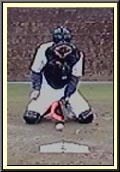
The ball coming right at you is the easiest to block:
- Drop both knees to the ground with your glove hand protecting the ball from going between your legs and your throwing hand providing more blocking area at your side.
- Keep your knees apart and your back straight to provide the largest target.
- Lean slightly forward with your chest square to the ball.
- Roll your shoulders slightly forward.
- Once in position try to relax.
What does relaxing have to do with it? Think of it this way. If you throw a ball against a brick wall, the ball is going to bounce back to you. If you put a pad in front of the brick ball and throw the ball again, the ball will hit the pad and drop. If your chest is rigid and doesn't give when the ball hits it, the ball will act like it's hitting that brick wall and may bounce a long way. If you relax your body before impact and allow some give when the ball hits you, the ball will act more like it's hitting a pad than a brick wall.
Just Off The Plate To Your Left Or Right
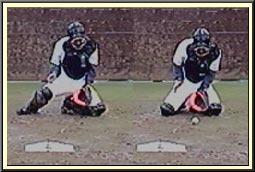
If the pitch is going to bounce slightly to your left:
- Drop your left knee to the ground on your left side. This is going to establish your blocking position.
- As you drop your left knee your right knee will will follow. Make sure your knees are apart.
- Once you have done this, move your hands, back and shoulders into the same position you would when blocking a pitch directly in front of you.
The same technique applies on a pitch to your right.
Player Tip
Keeping your balance should not be a problem when blocking a pitch slightly to the side. If you find that you're off balance and sometimes fall to the side when trying to block this pitch, it may be that you're dropping your knee to much in front of you instead of off to the side. When this happens, you will feel the need to learn your body to the side to try and get in position. Another reason for being off balance in this situation is trying to block a ball that is too far away by dropping your knee. With a ball that is farther away, you need to step before you drop. This technique is discussed below and on the next page.
Pitch Farther From The Plate
If you determine that dropping a knee to the side will put you close to but not in a good position to block the pitch, you will want to add a small step to the technique we have already covered.
- Take a small step with the foot that is on the same side as the pitch before dropping the knee.
- drop the knee and follow the technique as described above.
Keeping your balance can be an issue when you add this step. To help you keep your balance practice having your lead knee slide along the ground. This will help you keep your balance and with practice the sliding can put you in a better position to block the ball. Remember balance and position are essential to blocking the ball.
Not Even Close To The Plate
There are going to be pitches that are thrown farther from the plate that you will still be able to block and require more movement than described in the techniques on page 1. These pitches require quick reaction and are difficult to get to. The momentum you generate as you move to the ball makes it difficult to keep your balance. You will need to practice this technique over and over to become comfortable and skilled.
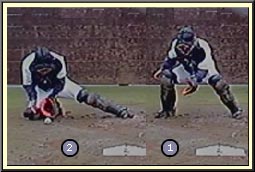
If the pitch is outside and bounces to your right:
- Step out with your right foot. Make sure you turn your foot in the direction you're going as you step.
- Sit down on your right knee with your left leg extended out along the ground. This will help you keep your balance as you go after the ball.
- Keep your upper body as you would in the technique described above.
These instructions really over simplify the skill required. You'll understand the first time you try the technique. It requires quick lateral movement and balance. Two things that are difficult to achieve when you move from a squatting position to sitting on one knee.
One of the most common problems in blocking this ball is allowing your upper body to turn in the direction you are going. This causes the ball to bounce away from you to the side instead of staying in front of you. In most cases this allows the baserunner to advance. To keep your upper body square, it's important to slide on your planted knee and use your back leg to stabilize yourself. This takes practice to learn how to keep your balance and keep yourself square to the ball at the same time.
The Pitch You Can't Get In Front Of
When using the technique above, you'll find that sometimes you just can't get in front of the ball. When this happens you have no other option than trying to catch it. In this case you will perform the same technique as above with a couple of adjustments.
- Step out and drop as you normally would on a ball you can block.
- Let your glove continue out past your body to position it to catch the ball.
- As you reach for the ball allow your upper body to rotate and bring your back leg forward. This will give you greater range for reaching out and catching the ball.
Breaking Pitches
A fastball is the easiest to block since it bounces more true than a breaking pitch. With a breaking pitch, you must take into account the spin on the ball and the trajectory of the pitch. For example, a curveball breaks down from a higher trajectory than a fastball. This results in a higher bounce than the fastball. The spin of the ball can cause the bounce to go to one side or the other. To successfully block a curveball, be aggressive in getting close to where it will bounce and position your body off center to account for the bounce. As with all pitches, experience will help you determine where a ball is going after it bounces.

Most Recent Blog Posts
Working With Players on Focusing on the Correct Part of the Baseball when Hitting (October 15 2016)
Getting More Accurate Throws From Your Team (April 5 2016)


Youth Coaching Advice
Blocking a pitch is a difficult skill to master. Start by working on blocking the pitch directly in front and slightly to the side. Once your catchers have this skill, then work on having them take a slight step and block. Depending on the age and skill level this may be all they are able to handle.
I found your website by "googling" for a baseball website to give me some advice about helping my grandson with basic skills. I have been reading with great interest until my eyes get "bleary". Good stuff. Really good stuff. You are providing the kind of advice I was looking for and you do a very thorough job of it. Keep up the great work.
A big fan,
- Stephen B.